There is an important technical point that should be clarified before thus and so there writing such an essay: Polygon does not use mining hardware in the traditional sense. The Polygon PoS( Proof-of-Stake) network is secured through a Proof-of-Stake architecture in which validators stake POL tokens and run validator infrastructure rather than competing with specialized mining machines such as Bitcoin ASICs. Polygon's architecture is very much based on the Heimdall consensus layer and the Bor execution layer, with validators producing and validating blocks through staking and consensus rather than computational mining. The emergence of Polygon's validator infrastructures represents a significant technological departure from the specialized cryptocurrency mining hardware that characterized earlier blockchain systems. Traditional blockchain networks such as Bitcoin rely on highly specialized Application-Specific Integrated Circuits (ASICs), purpose-built machines that perform en...
Get link
Facebook
X
Pinterest
Email
Other Apps
Oxygen-28 observed in laboratory
Oxygen-28 observed in laboratory
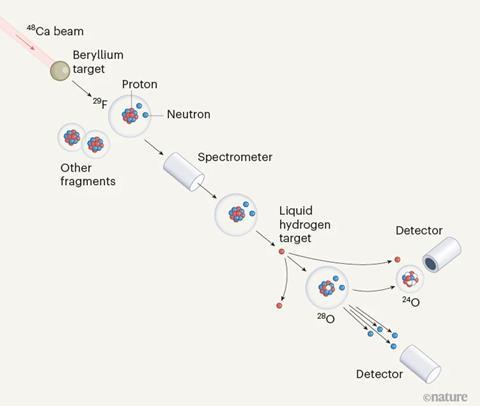
Oxygen-28 () has been observed for the first time in the laboratory by the humans which somewhat are from and have been living on this planet Earth for the last 200 years, more precisely by a team of researchers at the Tokyo Institute of Technology, allegedly. The team was led by a researcher designated as Yosuke Kondo, and set out to investigate these phenomena using a powerful particle accelerator at the Riken Nishina Center in Japan, or at least that's what an article from the magazine Chemistry World says. With 20 neutrons and eight protons, oxygen-28 would be the heaviest oxygen isotope ever created and would be expected to have doubly magic properties. This is a report on the first observation of 28O and 27O through their decay into 24O and four and three neutrons, respectively. The 28O nucleus is of particular interest as, with the Z = 8 and N = 20 magic numbers, it is expected in the standard shell-model picture of nuclear structure to be one of a relatively small number of so-called ‘doubly magic’ nuclei, says an article from the magazine Nature, article published by the same team of researchers mentioned above. The team made the isotope by bombarding an array of beryllium foils with calcium-48, causing the calcium nuclei to fragment. Fluorine-29 nuclei, which have the same number of neutrons as oxygen-28, were separated from the resulting products and then fired at a liquid hydrogen target. This collision caused some of the fluorine-29 nuclei to lose a proton, producing oxygen-28 nuclei.
Both 27O and 28O were found to exist as narrow, low-lying resonances and their decay energies are compared here to the results of sophisticated theoretical modelling, including a large-scale shell-model calculation and a newly developed statistical approach. In both cases, the underlying nuclear interactions were derived from effective field theories of quantum chromodynamics. But despite its number of protons and neutrons, the researchers discovered that oxygen-28 doesn’t seem to possess the stability that would be expected of doubly magic nuclei. Instead, the nuclei appear to form only fleetingly, before losing four neutrons to decay into oxygen-24. This suggests that the nuclei don’t actually have closed neutron shells and raises intriguing questions about the predicted energy gaps between the neutron shells. Finally, it is shown that the cross-section for the production of 28O from a 29F beam is consistent with it not exhibiting a closed N = 20 shell structure.
Comments
Post a Comment