AADS 1

Featured

DeSoc and Decentralised Blogging Platforms - INLEO - Non-Elaborate Posts - Post 1

   When a participant elects to relocate their LEO tokens across disparate blockchain networks, INLEO’s system implements a trust-minimized locking and minting (and conversely, burning and unlocking) architecture: specifically, a user deposits native LEO tokens into a cryptographic smart contract or analogous lock-module on the source chain; that contract irrevocably locks (escrows) those tokens, thereby removing them from liquid circulation on that origin chain. In response, an equivalent number of “wrapped” tokens (for example, wLEO on Ethereum, bLEO on Binance Smart Chain, or pLEO on Polygon) are algorithmically minted (or issued) on the target chain, subject to provable attestations via oracles or cross-chain relay/bridge protocols. If the user later desires reconversion, the wrapped tokens are irreversibly burned on the target chain, and the previously locked native tokens are released back to the user’s address on the source chain. This bi-directional mint-burn / lock-un...

New method for synthesising methylenecyclobutane compounds with copper catalyst


New method for synthesising methylenecyclobutane compounds with copper catalyst


      Methylenecyclobutane is a chemical molecular compound with a molecular weight of about 68.12 g/mol and mass of about 68.062600255 g per mol or at least that is what PubChem claims and has written on its website. Methylenecyclobutane is a molecular compound with a monoisotopic mass of about 68.062600255 g per mol and a heavy atom count of 5 or at least that is what PubChem claims and shows on its websites. 

      The molecular formula for methylenecyclobutane is equation, and on PubChem's website it says it is a highly inflammable fluid and vapor. Synonyms for the name of this compound are: methylidenecyclobutae and exo-methylenecyclobutane.

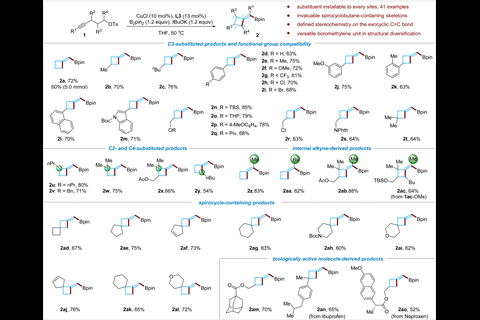
      (In the image above you can see diagrams of some of the alkyne materials that the reaction tolerates.)

      Certain researchers in China have developed a method for synthesising a variety of methylenecyclobutane derivatives. Previous challenges surrounding regioselectivity, stereoselectivity and functional group tolerance have been overcome, so could make these underexplored compounds more accessible to medicinal chemists. The work was led by a researcher named Bo Su. The method which was developed by Su’s team, transforms available linear alkynes into (boromethylene)cyclobutanes via a copper-catalysed borylative cyclisation reaction. It requires reaction conditions of about: 50°C for a maximum of 20 hours, and achieves excellent yields. Mechanistic studies found that high β-regioselectivity in a borylcupration step is achieved thanks to the help of an N-heterocyclic carbene ligand on the copper catalyst helps and promotes strained ring-closure in a vinyl copper intermediate, allegedly. Bo Su’s team demonstrated how the boromethylene groups could be converted into a range of other functional groups.

Reference

https://www.chemistryworld.com/news/copper-catalyst-behind-general-strategy-for-synthesising-methylenecyclobutane-compounds/4017846.article


Comments