There is an important technical point that should be clarified before thus and so there writing such an essay: Polygon does not use mining hardware in the traditional sense. The Polygon PoS( Proof-of-Stake) network is secured through a Proof-of-Stake architecture in which validators stake POL tokens and run validator infrastructure rather than competing with specialized mining machines such as Bitcoin ASICs. Polygon's architecture is very much based on the Heimdall consensus layer and the Bor execution layer, with validators producing and validating blocks through staking and consensus rather than computational mining. The emergence of Polygon's validator infrastructures represents a significant technological departure from the specialized cryptocurrency mining hardware that characterized earlier blockchain systems. Traditional blockchain networks such as Bitcoin rely on highly specialized Application-Specific Integrated Circuits (ASICs), purpose-built machines that perform en...
Get link
Facebook
X
Pinterest
Email
Other Apps
New measurement of electron electric dipole moment
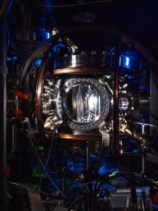
Physicists at the University of Colorado, Boulder, US have determined the shape of the electron’s charge distribution to unprecedented precision. Led by Eric Cornell and JunYe, the team that made the new discovery, allegedly, found that any imbalance in this charge distribution, the electron’s electric dipole moment, or eEDM, must be less than 4.1 x 10⁻³⁰ e cm, with an uncertainty of 2.1×10⁻³⁰ e cm, or at least that's what an article from Institute of Physics's Physics World magazine claims. One way to look for new particles is to do it directly, by smashing known particles together in large particle accelerators such as the Large Hadron Collider (LHC) at ever increasing energies. The alternative is to do it indirectly, by looking for tell-tale signs of new particles in the charge distribution of the electron.
But what is electron's electric dipole moment? The electron's electric dipole moment is made up as a product between the charge of the electron and the distance between its two constituent charges. The electron's electric dipole moment is a characteristic of the electron's electric dipole. Do not allow yourself to confuse the electron's electric dipole moment with electron's magnetic dipole moment for regardless of it being similar it a different phenomenon. In contrast to electron's magnetic dipole moment, an electric dipole moment (EDM) could only occur if the charge distribution of the electron is distorted slightly. The presence of such a distortion would mean that the electron no longer obeys time-reversal symmetry, which is the fundamental requirement that physics is the same whether time flows forwards or backwards. The electron has a magnetic moment due to its spin, and can be thought of as a rotating charge generating a magnetic dipole. To understand why this symmetry would be violated, consider what would happen if time reversed. The electron would then spin the opposite way and the direction of its magnetic moment would flip. The eEDM, however, is a result of a permanent charge distortion, so it would remain unchanged. This is a problem, because if we start with both moments parallel, a time reversal leads to them being antiparallel, violating time symmetry.
Extensions to the Standard Model of particle physics that was developed by the humans which somewhat are from and live on this planet Earth, such as supersymmetry predict the existence of many new particles at energies higher than any discovered so far. These new particles would interact with the electron to give it a much larger eEDM. Searching for a non-zero eEDM is therefore a search for new physics beyond the Standard Model and a hunt for a “marker” of new particles. The Standard Model mentioned above, only allows for a very small amount of time-symmetry violation, so it predicts that the electron’s electric dipole moment cannot be more than ~10-36 e cm. This is much too small to be experimentally testable even with current state-of-the-art equipment. To measure the eEDM, the CU-Boulder researchers detect how an electron wobbles in an external magnetic and electric field. This wobble, or precession, is similar to the rotation of a gyroscope in a gravitational field. When an electron is placed inside a magnetic field, it will precess at a specific frequency thanks to its magnetic moment. If the electron also has an EDM, applying an electric field will change this rate of precession: if the electron is orientated in one direction with respect to the electric field, the frequency of precession will speed up; if it’s “pointing” in the other direction, the rate will slow down.
Comments
Post a Comment